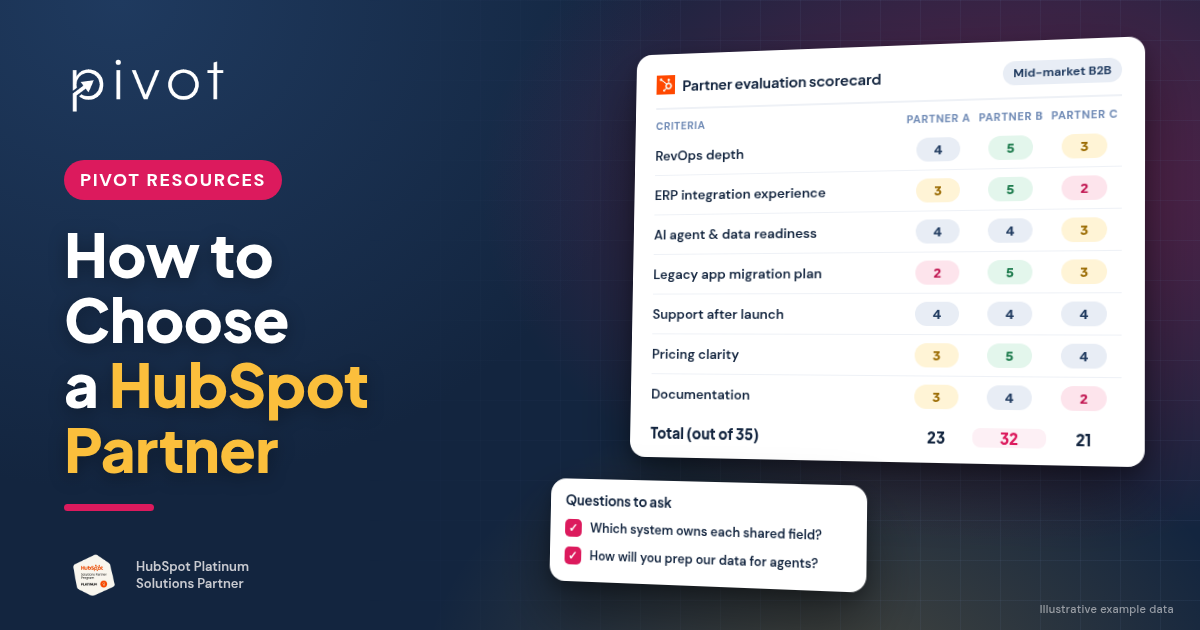
Short answer: The right HubSpot partner for a mid-market B2B company is the one that can fix the data, integrations and reporting your revenue team depends on, not just set up tools. Use a checklist. Check RevOps depth, ERP and NetSuite integration experience, how the partner prepares your data for HubSpot's AI agents, how they price and document their work, and who supports you after launch. A partner's tier and badges are a starting filter, not the decision.
Mid-market teams usually look for a partner when HubSpot stops keeping up with the business. Reports don't match Finance, an integration needs rebuilding, or leadership wants to use HubSpot's AI agents and nobody owns the setup. HubSpot's Fall 2026 Spotlight at UNBOUND (Sept. 16–18) raised the stakes. It put more AI, more agents and more data features inside HubSpot, and all of them depend on how well your portal is built.
This checklist helps you compare partners on what actually matters for a mid-market B2B team.
What does a HubSpot Solutions Partner do?
A HubSpot Solutions Partner is an agency or consultancy in HubSpot's partner program that implements, integrates, manages or optimizes HubSpot for customers. HubSpot lists partners in its Solutions Directory with their tier, accreditations, services, industries and customer reviews. Partners range from marketing agencies that also do HubSpot to technical firms focused on CRM architecture, integrations and RevOps.
Why mid-market B2B teams need a different kind of partner
Mid-market companies sit in an awkward spot. Your setup is too complex for a basic onboarding package: several hubs, an ERP, custom objects, multiple teams and real revenue reporting. But you often don't have an in-house HubSpot admin or developer. That means you need a partner who can:
- Design a data model that holds up across sales, marketing, service and finance.
- Build and maintain integrations with an ERP like NetSuite, billing tools and legacy systems.
- Deliver revenue reporting leadership trusts.
- Stay involved after launch, because HubSpot keeps changing.
The HubSpot partner checklist for mid-market B2B
1. RevOps depth, not just marketing execution
Ask how the partner designs pipelines, lifecycle stages, handoffs and revenue reporting across teams. A strong RevOps partner starts from the reports leadership needs and works backward to the data.
Ask:
- "Show me how you'd define lifecycle stages and pipeline stages for a company like ours."
- "How do you make sure HubSpot revenue numbers reconcile with Finance?"
- "Who on your team owns the data model, and what happens when it needs to change?"
2. Proven ERP and NetSuite integration experience
If HubSpot needs to share customers, orders, invoices or products with NetSuite or another ERP, integration design will make or break your reporting. Look for a partner who decides which system owns each field before building anything. We explain why in Why Custom CRM Integrations Break HubSpot Reporting.
Ask:
- "Which system will own each shared field, and how will you document that?"
- "How will records match between HubSpot and our ERP?"
- "How do you monitor sync failures, and who gets alerted?"
- "Is the integration scoped at a fixed price or billed hourly?"
3. A plan for HubSpot's 2026 developer changes
HubSpot announced at Fall Spotlight that v1–v3 APIs, legacy public apps and legacy private apps will become unsupported in September 2027. It also announced that creating new legacy private apps ends on October 26, 2026 for existing accounts. Service keys, now in public beta, are the replacement for legacy private apps (HubSpot developer changelog). If your integrations run on custom code, your partner should already have a migration plan.
Ask:
- "Which of our integrations use legacy private apps or older API versions?"
- "What's your plan and timeline to migrate them before September 2027?"
4. AI and agent readiness, grounded in your data
The Fall 2026 Spotlight introduced several things:
- Growth Context and Context Home, where you manage the business context HubSpot's AI uses.
- An all-new Breeze Assistant, available across all hubs and tiers.
- A redesigned Agent Hub and Agent Builder for managing and building agents. HubSpot says these require Professional or Enterprise (Fall 2026 Spotlight developer updates; Spotlight announcement).
Agents are only as good as the CRM data and context they read. A partner who builds agents on a messy portal will give you confident, wrong answers. Most of the new AI features also consume HubSpot Credits, so badly targeted agents cost money.
Ask:
- "How will you get our data and Context Home ready before building agents?"
- "Which agent would you build first for us, and how will we measure whether it's working?"
- "Which of these features need Professional or Enterprise, and is an upgrade actually justified?"
- "How will you keep credit usage tied to work that matters?"
5. Hands-on admin and support after launch
HubSpot ships updates constantly, and your business changes too. Ask what happens after the project ends. Does the partner offer ongoing admin, a support retainer or a subscription? Or do you go back to filing tickets? If you're weighing this against hiring, see In-House RevOps vs. Retained Partner: The Real Cost Comparison.
Ask:
- "Who is our day-to-day contact, and how fast do you respond?"
- "What's included each month, and what costs extra?"
6. Clear pricing and scoping
Mid-market budgets need predictability. Look for clear scopes, fixed prices where possible, and paid discovery for large projects so the estimate is based on your real setup rather than a guess.
Ask:
- "What's fixed price and what's variable?"
- "What's out of scope, and how are changes handled?"
7. Documentation and ownership
You should own your portal, your integrations and the documentation behind them. Ask what you'll receive: field ownership matrices, integration maps, workflow documentation and admin guides.
Ask:
- "If we stopped working together, what would we have in hand?"
8. Relevant experience in your industry and stack
Ask for examples that match your industry, systems and complexity, such as manufacturing with ERP sync, SaaS attribution or recurring-revenue service businesses. Check reviews in HubSpot's Solutions Directory, which HubSpot redesigned at Fall Spotlight to help buyers find the right partner faster.
Ask:
- "Can you walk me through a project like ours, including what went wrong?"
- "Can we speak with a reference customer?"
9. Partner tier and accreditations (as a filter)
A partner's tier reflects their size and track record in HubSpot's program, and accreditations show verified expertise in specific areas. Both are useful filters. Neither tells you whether the partner fits your data, integrations and team. Use them to build a shortlist, then use the questions above to choose.
What are the red flags when choosing a HubSpot partner?
- They propose tools and agents before asking about your data or reports.
- They can't explain which system owns your shared data.
- Pricing is open-ended hourly with no defined scope.
- They have no plan for HubSpot's legacy app and API changes.
- Documentation isn't part of the deliverables.
- Support after launch is vague or costs extra for basic changes.
- They recommend a tier upgrade without tying it to a specific outcome.
How to run a partner evaluation in two weeks
- Write down the problem. List the three to five outcomes you need, such as trusted revenue reporting, a working NetSuite sync or one AI agent in production.
- Shortlist three partners using the Solutions Directory, tier, accreditations, reviews and industry fit.
- Send the same questions from this checklist to each partner.
- Ask for a short discovery or audit so the proposal is based on your actual portal.
- Score each partner on RevOps depth, integration experience, AI readiness, support, pricing clarity and documentation.
- Check references and decide.
Frequently asked questions
Does a higher HubSpot partner tier mean a better partner?
Not necessarily. Tier reflects a partner's track record and size in HubSpot's program. Fit depends on whether they've solved problems like yours, such as RevOps, ERP integration and reporting, for companies your size.
Should we choose a HubSpot partner that specializes in our industry?
Industry experience helps, especially when your systems are specific to your industry, such as an ERP in manufacturing or recurring service contracts in AV. Technical depth in your stack usually matters more than industry alone.
What should a HubSpot partner do before building AI agents?
Review your data quality, data model and business context first. HubSpot's agents read from your CRM and Context Home, so cleaning and structuring that data is step one.
Do we need HubSpot Enterprise to use AI agents?
Breeze Assistant is available across all hubs and tiers. HubSpot says Agent Hub and Agent Builder require Professional or Enterprise. A good partner will tell you which features you actually need before recommending an upgrade.
How much does a HubSpot partner cost?
It depends on scope. Many partners price by project or monthly retainer. Pivot publishes its pricing: the HubSpot Admin Subscription starts at $2,500/month, and Project Blueprint paid discovery is $2,500, credited toward the build.
How Pivot fits
Pivot has been a HubSpot Solutions Partner since 2014 and is a Platinum partner. We focus on the technical side of HubSpot for mid-market B2B teams:
- CRM consolidation
- Integrations, including fixed-price NetSuite and QuickBooks integrations
- Revenue reporting
- HubSpot AI enablement
- Ongoing admin through our HubSpot Admin Subscription
See real builds and client reviews. Not sure where your portal stands? Start with a free instant HubSpot audit.
Evaluating HubSpot partners? Talk to Pivot about your portal.
