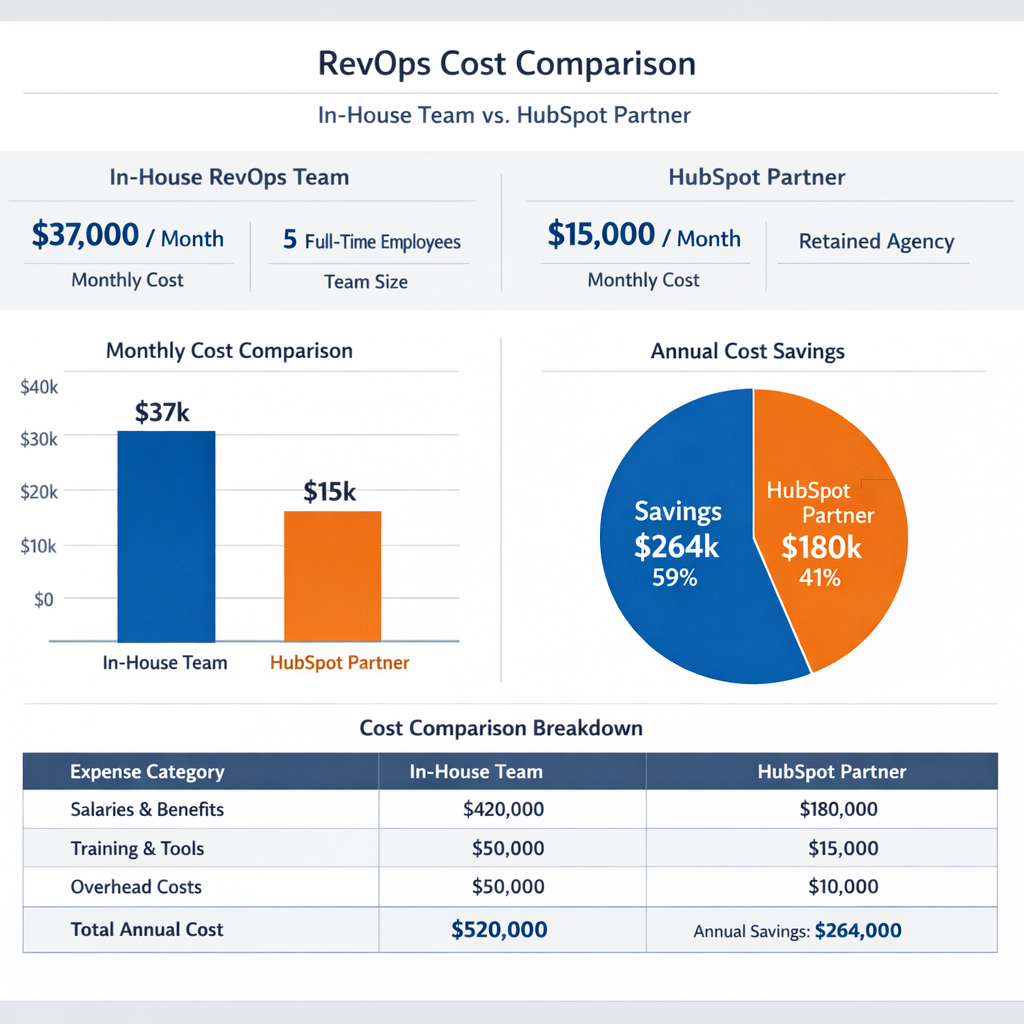
A grounded cost comparison between in-house RevOps and a retained HubSpot partner.
Where RevOps costs actually hide
Licenses are the obvious line item; RevOps is the multiplier
If you’re a CFO or COO looking at a HubSpot-centric stack, your first instinct is usually to look at software line items. That’s fine for the first pass. But the real leverage — good or bad — shows up in how well your RevOps function runs the system. A messy RevOps setup turns every new tool into a friction point. A well-run one turns the same set of tools into something people actually use.
The cost of RevOps isn’t just the salary of whoever has “operations” in their title. It’s the extra hours your VP Sales spends manually reconciling the pipeline, the reporting analyst you hired because dashboards never quite match reality, and the implementation fees you pay every time you switch point tools.
The question on the table isn’t “Should we pay for RevOps?” You’re already paying, one way or another. The question is whether that spend should sit primarily in-house, with a retained partner, or some mix of the two.
Inventory the work before you price the function
Before you compare costs, list the actual RevOps jobs your company needs done over the next 12–24 months. For a 250–1,000 employee B2B company, that list usually includes things like:
-
Implementing or rebuilding HubSpot (Sales, Marketing, Service, or all three).
-
Cleaning up the data model (custom objects, association labels, property sprawl).
-
Integrating finance and operational systems (ERP, billing, product data).
Then there’s the business-as-usual work:
-
Managing user access, pipelines, workflows, and automations.
-
Supporting go-to-market experiments — new territories, new segments, new product lines.
-
Keeping reports and dashboards honest enough that Finance and Sales can agree on a number.
This is the same inventory we walk through in our own True Cost Calculator with executive teams. Once you see the full list, the question shifts from “Can one person do this?” to “Which pieces belong on our payroll, and which are better rented from a team that lives in this stack all day?”
Modeling the total cost of ownership for each RevOps approach
Start with the real job description, not the wish list
Most "Head of RevOps" job descriptions read like three roles in a trench coat: admin, architect, and strategist. Before you build any cost model, write down what you actually expect this person or partner to do in the next 12–24 months.
For a mid-market B2B team, the list usually includes:
-
Owning the CRM and marketing automation stack (often HubSpot at the core).
-
Designing and maintaining data models, reports, and dashboards.
-
Supporting sales, marketing, and CS with process and workflow changes.
-
Handling vendor management and integration decisions.
If you expect a single full-time hire to also be your analytics engineer, solution architect, and project manager, your in-house cost model should reflect that. Either you’re going to pay senior-level cash for that talent, or you’re going to accept a slower, narrower implementation.
A retained HubSpot partner won’t magically give you one person who does everything either. What you’re buying is access to a small bench of people who each specialize in parts of this list — data architecture, integrations, AI automation, onboarding, and ongoing optimization.
At Pivot, our work often splits along those lines: one person focuses on HubSpot and data architecture, another on integrations (NetSuite, Salesforce, ServiceTitan, QuickBooks, Megasys, AI workflows via custom-coded actions), and another on ongoing change management with your GTM leaders.
Quantify salary, benefits, and ramp time realistically
Once you’ve scoped the job, put real numbers to the in-house path. For a mid-market US-based company, a capable RevOps leader with hands-on HubSpot experience is not a junior hire. You’re competing with SaaS and tech companies that have been hiring this profile for years.
Your total cost exceeds your base salary. It also includes:
-
Benefits and taxes.
-
Bonus or variable compensation.
-
Hardware, software, and training.
-
The 6–12 month ramp it takes for them to learn your stack and politics well enough to drive change.
On the partner side, your cost profile looks different:
-
A recurring services fee.
-
Some up-front project or onboarding work.
-
Internal time from your GTM and ops leaders to participate in projects.
You’re not avoiding the need for internal ownership; you’re choosing to rent certain skills instead of hiring them. If you want to pressure-test your own numbers, our True Cost Calculator is built to help executives align software and services costs with headcount in a way that matches how budgets actually work.
How to staff and scope for mid-market reality, not startup fantasy
A single unicorn hire is not a scalable plan
If your whole RevOps strategy depends on one person who “knows everything,” you don’t have a strategy; you have key-person risk. In-house, that looks like an admin who also runs board decks and owns every workflow. When they leave, your HubSpot instance and reporting cadence go sideways for six months. With a partner, it looks like a relationship that lives entirely in one consultant’s head. When they leave, critical knowledge walks out the door with them.
For a 250–1,000 person company, either model needs redundancy:
-
Internally, a senior RevOps lead plus at least one admin or analyst.
-
With a partner, clear documentation, recurring cadences, and more than one consultant who can work in your portal.
Make that part of your evaluation. Ask prospective hires how they’ve built bench strength in the past. Ask partners how they handle coverage when someone is out or moves on.
Use projects and assessments to de-risk both paths
You don’t have to make a long-term, all-or-nothing decision on Day One. A more practical approach is to use the first 3–6 months to test what works best in your environment. That might mean a scoped data architecture or integration project with a partner, a fixed-term contract with a senior RevOps leader, or a defined backlog of HubSpot and process work to clear. Then evaluate the outcomes that matter: Is the data model clearer? Are the integrations more stable? Are sales and CS leaders actually using the new reports? We structure much of our work at Pivot this way. Start with a focused engagement — integrations, AI and automation, data architecture, or onboarding — and use the results to decide whether ongoing support makes sense.Choose the RevOps model that fits your work
The right answer will differ by company. Some teams genuinely need a strong internal RevOps leader because their motion is complex, politics are local, and there’s an appetite to build a function. Others are better served with a lean internal owner and a retained partner who can bring patterns from dozens of other teams. If you do nothing else after reading this, map your next 12 months of RevOps work — implementations, migrations, data architecture, AI projects, integrations — and ask, “Which of these are one-time builds, and which are ongoing care and feeding?” One-time work tends to focus on projects and partners. Ongoing work tilts toward internal headcount. Your answer will usually emerge from that split.
If you want more context before you run the numbers, check out how we fit into that decision for mid-market teams specifically.
