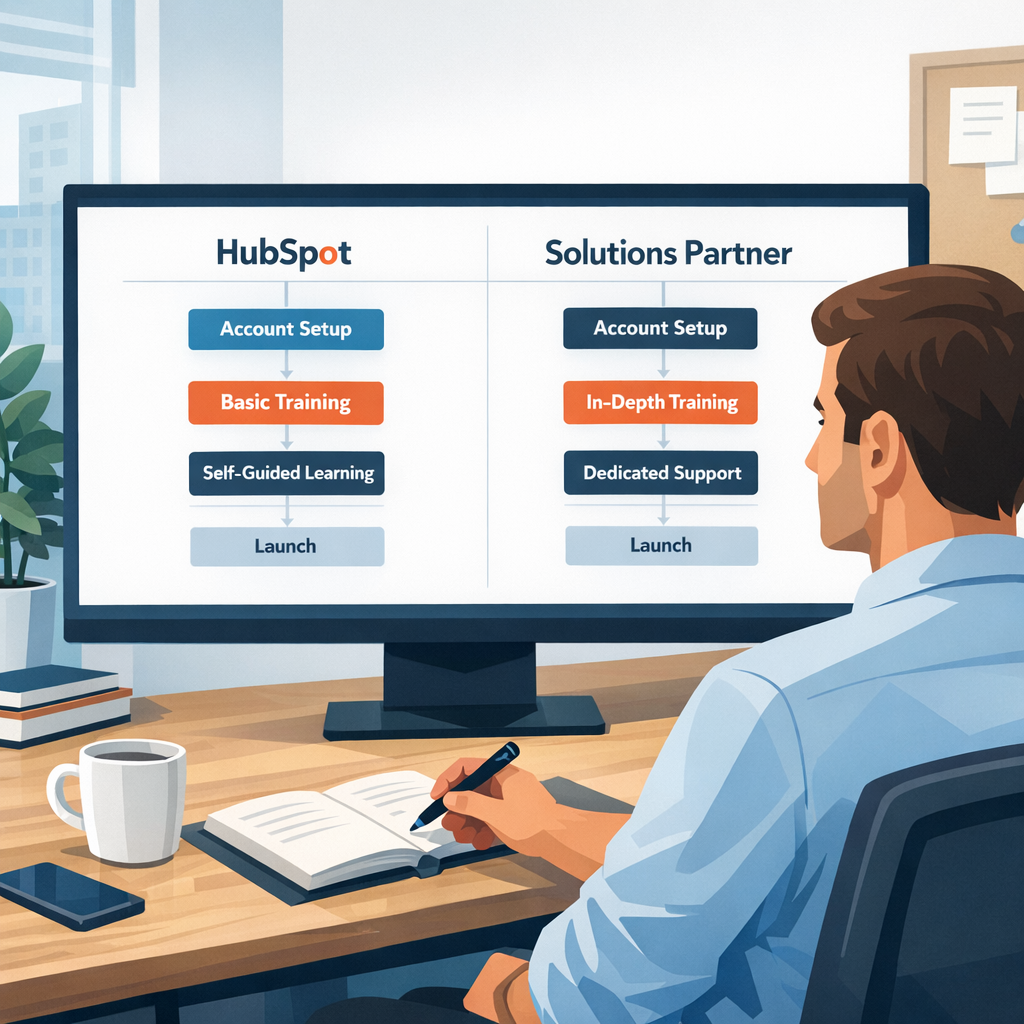
How to choose between HubSpot-led onboarding and a Solutions Partner without wrecking your first year on the platform.
When HubSpot-led onboarding works — and when it doesn’t for mid-market
If your HubSpot onboarding plan fits in a single line item called “required by HubSpot,” you’re already behind.
Mid-market teams usually come to HubSpot in one of three states: migrating off a legacy CRM, stitching together point tools into something survivable, or finally admitting the data warehouse can’t be the only place anyone trusts. In all three, the first 90 days determine whether HubSpot becomes a system of record or an expensive address book.
The path you pick for onboarding — direct with HubSpot or through a Solutions Partner — sets the tone for everything that comes after. Not just “how fast you launch,” but who owns the data model, how deeply the platform gets integrated, and whether the Marketing, Sales, Customer Success, and Finance teams buy into the change.
On paper, the decision looks simple. HubSpot-led onboarding is standardized and tightly scoped. Partner-led onboarding is more flexible and, if we’re honest, more variable in quality. Underneath, the trade-offs are real.
This isn’t a generic “pros and cons” grid. It’s a look at what actually goes wrong — and right — in mid-market implementations depending on which route you choose. We’ll stay focused on B2B companies in the 250–1,000 employee band. If you’re a five-person startup or a 10,000-seat enterprise, your calculus is different.
And to be transparent about where we’re standing: Pivot has been a HubSpot Solutions Partner since 2014 and currently operates at the Platinum tier. We offer HubSpot onboarding and implementation, but we also come into the fold after many direct onboardings to clean up what mid-market complexity has exposed.
The point here is not “always pick a partner.” It’s “pick with a clear view of what you’re really buying and what your internal team can carry.”
Where HubSpot-led onboarding tends to crack for mid-market teams
HubSpot-led onboarding is built to be repeatable. That’s the point. You get a scoped plan, a defined number of sessions, and a clean checklist to get core tools online: domains connected, pipelines created, forms and emails sending, and basic reporting in place. For a lot of smaller teams, that’s enough.
Mid-market reality is messier. You are not starting from zero. You’re walking in with:
- Existing systems: A primary CRM or data warehouse, a finance stack, ticketing, and product data.
- Real revenue at risk: Active renewals, in-flight deals, support queues you can’t pause for 90 days.
- People with opinions: Sales, Customer Success, Marketing, and Finance, who all care how data lands.
That’s where we see HubSpot’s direct onboarding crack for mid-market teams. Not because the onboarding team is bad. Because their charter is narrow by design.
A few patterns show up over and over:
- Data decisions get rushed. You make one-time calls on lifecycle stages, deal stages, or ticket pipelines in the second or third onboarding call because the clock is ticking. Those choices live in your reporting for years.
- Integrations are treated as a footnote. You get generic guidance like “you can connect this via Zapier or a custom integration” instead of a concrete pattern for NetSuite, ServiceTitan, QuickBooks, or whatever you actually run.
- No one owns the gaps between hubs. Marketing gets their side functional. Sales gets theirs. Service is “phase two.” No one is responsible for how a single customer flows end to end.
None of this is malicious. HubSpot onboarding is scoped to get you productive inside the product, not to re-architect your revenue operations. If you treat it like a full implementation, you’ll be disappointed.
When we come in after a direct onboarding, the work usually falls into three buckets:
- Unwinding overly clever workflows that were built to satisfy one stakeholder in a single call.
- Rebuilding the data model so Finance, Sales, and Customer Success can agree on basic numbers.
- Re-thinking integrations that were set up as one-way syncs “just to get data moving.”
If your motion is simple and you don’t have many systems to connect, you can live with some of that. If you’re a 250–1,000 person B2B company with multiple teams depending on HubSpot, those cracks show up in your first executive review.
That doesn’t mean “never buy HubSpot onboarding.” It means going in eyes open about what it is (a product onboarding program) and what it is not (a full-stack RevOps implementation).
If you want a sense of how HubSpot describes this scope, look at their overview pages — especially Customer Platform Onboarding and the hub-specific onboarding breakdowns. They’re explicit about where the line is.
This is where working with a Solutions Partner who lives in mid-market complexity can change the shape of the first 90 days. You still tick HubSpot’s onboarding box, but you point that budget at someone who can talk about custom object design, Customer Success Workspace, Breeze AI agents, and your finance stack in the same conversation.
That’s the lane Pivot lives in. We’ve been a HubSpot Solutions Partner since 2014, and we currently operate at the Platinum tier, but the thing that actually matters is this: we’ve broken and rebuilt enough onboarding projects to know where shortcuts age badly.
Assume the first three months are not just “learn the tool” months. They’re where you decide what your next five years of data and process will feel like to run.
If you want to see how this choice fits into a bigger cost picture before you sign anything, run your current stack through the True Cost Calculator. It will quickly show you whether you’re treating onboarding as a one-time line item or as the front door to a platform you’ll be living in for a long time.
Guardrails so your onboarding choice holds up after go-live
The biggest onboarding failure mode in mid-market isn’t choosing “wrong.” It’s pretending the choice doesn’t matter.
HubSpot’s requirement is simple: if you buy Professional or Enterprise, you need an onboarding plan. Their site spells out what you get in a direct engagement. What they don’t tell you — because it’s not their job — is whether that’s the right shape relative to your internal bench and risk profile.
A few guardrails will keep you out of trouble either way.
1. Write down a RACI before you sign anything.
Before you pick a path, document who is actually on the hook for what in the first 90 days. Not in marketing-speak — in real jobs.
- Who owns the data model — objects, key properties, and association labels?
- Who is responsible for pipeline and stage definitions that Finance will treat as real?
- Who is designing ticket pipelines, Customer Success handoffs, and Customer Success Workspace?
- Who is accountable for integrations: finance, product usage, and support tools?
If the answer to every line is “the HubSpot onboarding manager,” you’ve already made a risky bet. Their scope is to guide and advise; your team or partner has to own the parts unique to your business.
If you work with a Solutions Partner, this is where you should feel the difference. A serious mid-market partner will have opinions on which responsibilities belong to them, which should stay in-house, and which require an executive decision. The RACI is not a formality; it’s the contract for how work gets done when everyone is busy.
2. Decide what “good enough by Day 90” means.
Onboarding doesn’t need to deliver your five-year wishlist. It does need to deliver a stable foundation that you can build on without undoing everything next year.
For most 250–1,000 person B2B teams, “good enough by Day 90” looks like:
- One HubSpot data model you can diagram on a whiteboard without lying.
- Pipelines and stages that Sales leadership is willing to inspect in one-on-ones.
- Service Hub wired enough that real tickets are flowing and SLAs are visible.
- At least one Breeze AI pattern in production where the team actually trusts the output — often in prospecting or support triage.
- Reports that Finance can reconcile to their systems without a three-hour meeting.
Whether you go direct with HubSpot or through a Solutions Partner, ask each prospective team how they’ll get you to that baseline. If their answers stay at the “grow better” level, keep pressing until you hear concrete patterns, property names, and workflows.
3. Treat onboarding as the first project in a longer roadmap.
The other failure pattern we see: teams treat onboarding as the only budgeted project, then starve the next 18 months. You get a shiny go-live and then six quarters of slow data rot because nobody is resourced to maintain or extend the build.
A more honest model is:
- Onboarding (3–4 months): set the foundation, connect the critical systems, and stand up core motion(s).
- Stabilization (3–6 months): fix what broke under real usage, get honest reporting, and start layering in automation and AI where the process can support them.
- Optimization (ongoing): iterate on data, workflows, and enablement as your motion changes.
If you’re talking to a Solutions Partner who only wants to sell onboarding, ask what their version of stabilization and optimization looks like. If you’re going HubSpot-direct, ask who — inside your organization or outside — will own those phases when the onboarding manager rolls off.
At Pivot, most of our long-term clients came to us after a first pass at HubSpot onboarding that technically “worked” but didn’t hold up under growth. That’s why we built our ongoing support and optimization offer the way we did: as a continuation of the same work, not a separate track.
Teams that do best with HubSpot treat onboarding as the beginning of a continuous build, not as a compliance step before returning to business as usual.
If you do nothing else after reading this, spend one working session with your VP Sales, VP Marketing, Head of CS, and Finance lead. Write down the five decisions about data and process you absolutely do not want made on a rushed onboarding call. Then make those decisions yourselves — and hold your onboarding partner, whoever that is, to them.
