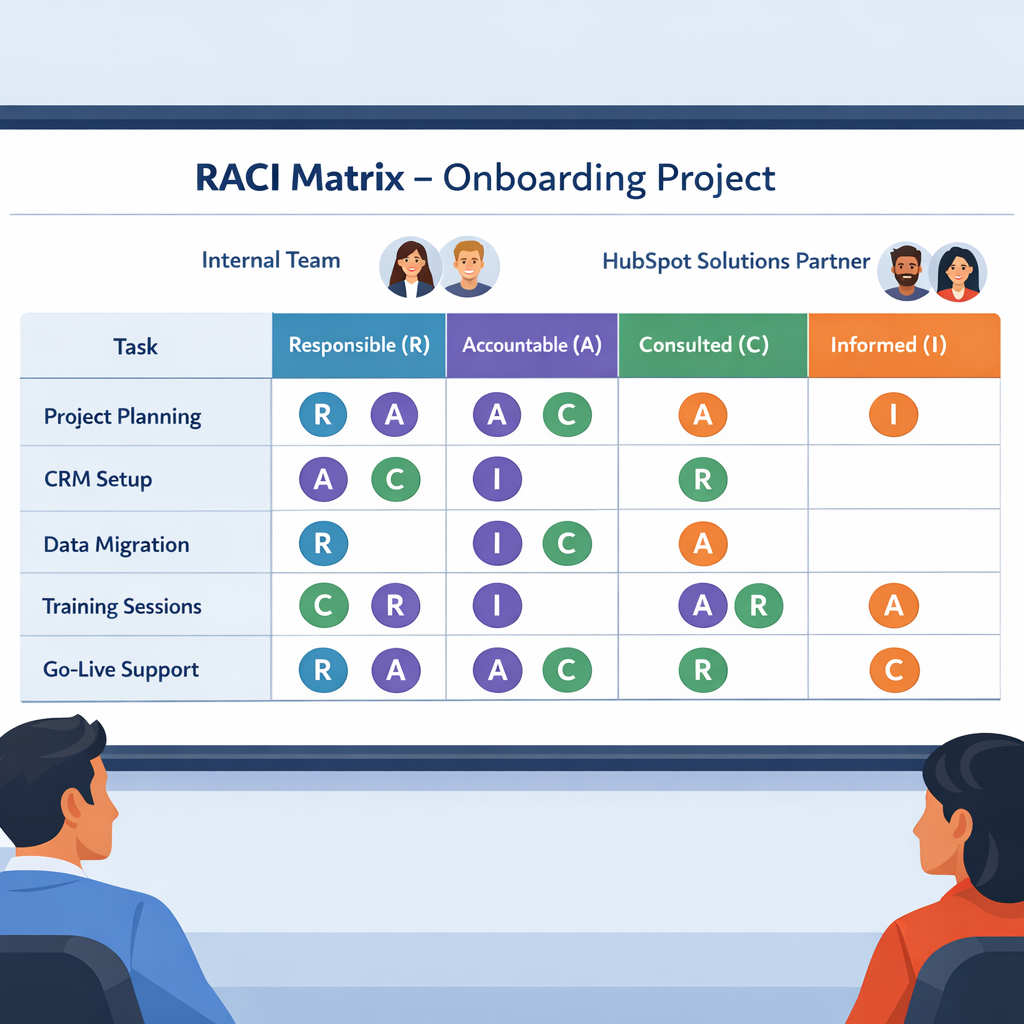
How to design a HubSpot onboarding RACI that splits work cleanly between your team and a Solutions Partner.
Where ownership actually breaks in HubSpot onboarding projects
Most bad HubSpot implementations are not the result of bad tools. They’re the result of unclear ownership.
If you’ve ever sat through a go-live where nobody can answer “Who decided to set lifecycle that way?” or “Why do we have three different renewal dates?” you’ve seen the outcome of an onboarding project that skipped the governance step.
The pattern is the same whether you onboard directly with HubSpot or through a Solutions Partner. Everyone is busy. Everyone wants to move fast. Decisions get made on a Tuesday afternoon Zoom by whoever showed up, and three months later you’re living with those calls in every report.
The way out is unglamorous: write down a RACI (Responsible, Accountable, Consulted, Informed) that covers the work you’re about to do and the work that will follow once you’re live. Then use it.
This isn’t about adding bureaucracy. It’s about acknowledging that a HubSpot implementation for a 250–1,000 person B2B company is not a “tools project.” It’s a set of choices about how revenue, service, and customer data behave.
In this article, we’ll stay practical:
- Where HubSpot onboarding and Solutions Partners typically pick up and drop responsibility.
- How to write a RACI that your VP Sales, Head of CS, and CFO will actually use.
- How to keep ownership from disappearing after everyone declares onboarding “complete.”
To be clear about the bias in the room: Pivot is a HubSpot Solutions Partner, Platinum tier, and we offer HubSpot onboarding and implementation. We’ve also been the second partner into more than one portal where the first go at onboarding left everyone with half answers and a lot of custom fields.
The goal here isn’t to sell you a methodology. It’s to give you a way to keep control of your own implementation when outside help — including us — is in the mix.
Designing a shared implementation plan with a Solutions Partner
The reason so many mid-market implementations feel like a blur is simple: nobody wrote down who owns what until after the project slipped.
You can feel this in the first discovery call. Everyone nods along when someone says “we’ll handle that together,” but when you get to decision points, suddenly it’s not clear whose job it is to decide.
A RACI for onboarding sounds like project-management wallpaper until you watch a project without one. That’s where you get:
- HubSpot is requesting sign-off on a pipeline design that no one internally has vetted.
- A Solutions Partner quietly makes object and property calls because someone has to, and the steering group is overbooked.
- Internal admins are hacking workflows in production because the partner’s backlog is full and Sales needs something “for Monday.”
A good RACI is not a spreadsheet for its own sake. It’s a forcing function to answer, in plain language, “Who does this work? Who gets a veto? Who just needs to be looped in?”
For a HubSpot implementation that touches Sales, Marketing, Service, and Finance, the list of real jobs is short but sharp:
- Data owner: the person who decides what “source of truth” means for revenue, product, and support data.
- Process owner(s): Sales, CS, and Marketing leaders who sign off on how work moves through HubSpot.
- Platform owner: the person or team who will live with the admin keys after everyone else moves on.
- Partner lead: your primary counterpart inside the Solutions Partner, if you use one.
Everything else hangs off those roles. If your RACI has twenty people with “approve” next to their name, you haven’t designed an implementation; you’ve designed a stalemate.
Start with the high-risk domains:
- Lifecycle and Deal stage definitions.
- Customer Success Workspace setup and health scoring.
- Ticket pipelines and SLAs.
- Critical integrations: ERP, billing, product usage.
For each, be specific. “RevOps” is not a person. `Jane (VP RevOps)` is. So is `Raj (Head of CS)` and `Casey (CFO)`. Put real names next to decisions. When questions come up mid-implementation — and they will — you’ll know who to pull into the conversation instead of arguing in Slack about “what Finance wants.”
If you’re working with a Solutions Partner, treat their team the same way. Name their architect, their project manager, and their HubSpot admin. Ask which of them will be on every working session and which are specialists you see only when needed. If they can’t answer that cleanly, they’re not ready to run a mid-market build.
We run our own engagements this way at Pivot because we’ve seen what happens when we don’t. The RACI is boring until it saves the quarter.
If you want a parallel way to think about ownership beyond onboarding, our take on reading your HubSpot data model like an admin maps the same idea onto day-to-day operations.
For execs, pairing this with the True Cost Calculator helps frame RACI not as bureaucracy but as protection for the spend you’re about to commit.
Governance so your implementation doesn’t rot after onboarding
A good RACI doesn’t prevent change. It gives you a way to change on purpose instead of by accident.
Once you’re live, the temptation is to treat onboarding as “done” and let everyone go back to their day jobs. That’s when ghost admins appear, and the instance starts to drift.
Lock in a few governance habits while the project is still warm:
- A monthly “changes” review where your internal owner and your partner walk through new properties, workflows, and integrations.
- A simple intake process for new requests, with a triage like “quick fix,” “needs design,” or “belongs in the roadmap.”
- Quarterly check-ins with Finance to make sure reporting and forecasting still line up with how they run the business.
That’s not ceremony; it’s how you make sure the work you just did to stand up HubSpot onboarding doesn’t quietly erode over the next six quarters.
If you want an external benchmark for what “grown-up governance” looks like without going full enterprise, the platform consolidation article is worth a read next: Platform Consolidation Math for HubSpot-Centric Stacks.
And if you’d rather not build this in isolation, this type of planning is baked into our onboarding and implementation and ongoing optimization work. We use the same patterns in our own portal before we suggest them to anyone else.
If you do nothing else, spend one hour before you sign with any partner — HubSpot or Solutions Partner — and write down your version of this RACI. If they can’t work inside it, that’s your signal.
